Resources
How to Prepare a Jewelry Tech Pack
A tech pack tells a factory what to make, precisely enough that two people reading it would build the same thing. This guide covers what goes in one and, for every item, what to do if you do not have it yet.
The checklist
What goes in, and what to do without it
Nothing here is a barrier to starting. The right-hand column is the important one.
| Item | What it is | If you do not have it |
|---|---|---|
| Overall dimensions | Length, width, thickness or diameter in millimeters | Send a photograph with a ruler or a coin beside the piece, or name a reference product |
| Material grade | The base alloy: 316L unless there is a reason to specify otherwise | Say what it is for and where it will be worn; the grade follows from that |
| Finish | Color and coating process, with a target thickness if you have one | Name a color, or send a physical reference. A screenshot is not a color reference |
| Tolerances | How much variation is acceptable on each critical dimension | We propose a standard tolerance set for you to approve. Most first projects go this way |
| Findings and closures | Post type, clasp type, jump ring gauge, hinge | Say how it should feel to put on and take off; the hardware follows |
| Construction notes | How parts join: soldered, riveted, hinged or set | Leave it. This is what DFM review is for |
| Packaging | Polybag, card, box, hang tag, and any artwork | Standard polybag unless you say otherwise. Artwork can come later |
| Quantity and date | Quantity per design and target launch | A range and a rough month. Precision here matters less than direction |
| Compliance requirements | Any testing or documentation your own buyer imposes on you | Send their requirement document. It frequently decides the material specification |
Common gaps
What slows a project down
A color named but not referenced
"Gold" covers an enormous range, and screens disagree with each other. Without a physical reference, the first sample is a guess and the second one is the real first attempt.
Post us a physical reference, or plan a color sample round into the schedule from the start.
One dimension where two were needed
A hoop has an inner and an outer diameter. A pendant has a size with and without its bail. Giving one figure where the difference matters produces a piece that is correct against the brief and wrong on the wrist.
Say which measurement each number refers to. It takes three words.
Tolerance left unstated
Without a stated tolerance, "wrong" has no definition, and a disagreement about a batch has no way to be settled other than by whoever argues longest.
Approve a standard tolerance set at the pre-production sample, so any later disagreement already has a written answer.
A reference photograph of a competitor's product
A competitor's product is a fine starting point for style, but it is not an instruction to copy. If a brief amounts to a copy, we will tell you before we go ahead, so the exposure does not end up with you.
Tell us what you like about it, and let the design differ from it.
Download
The checklist as a file
Tech pack checklist
A one-page checklist of the fields above, to fill in or hand to a designer.
Tech pack template
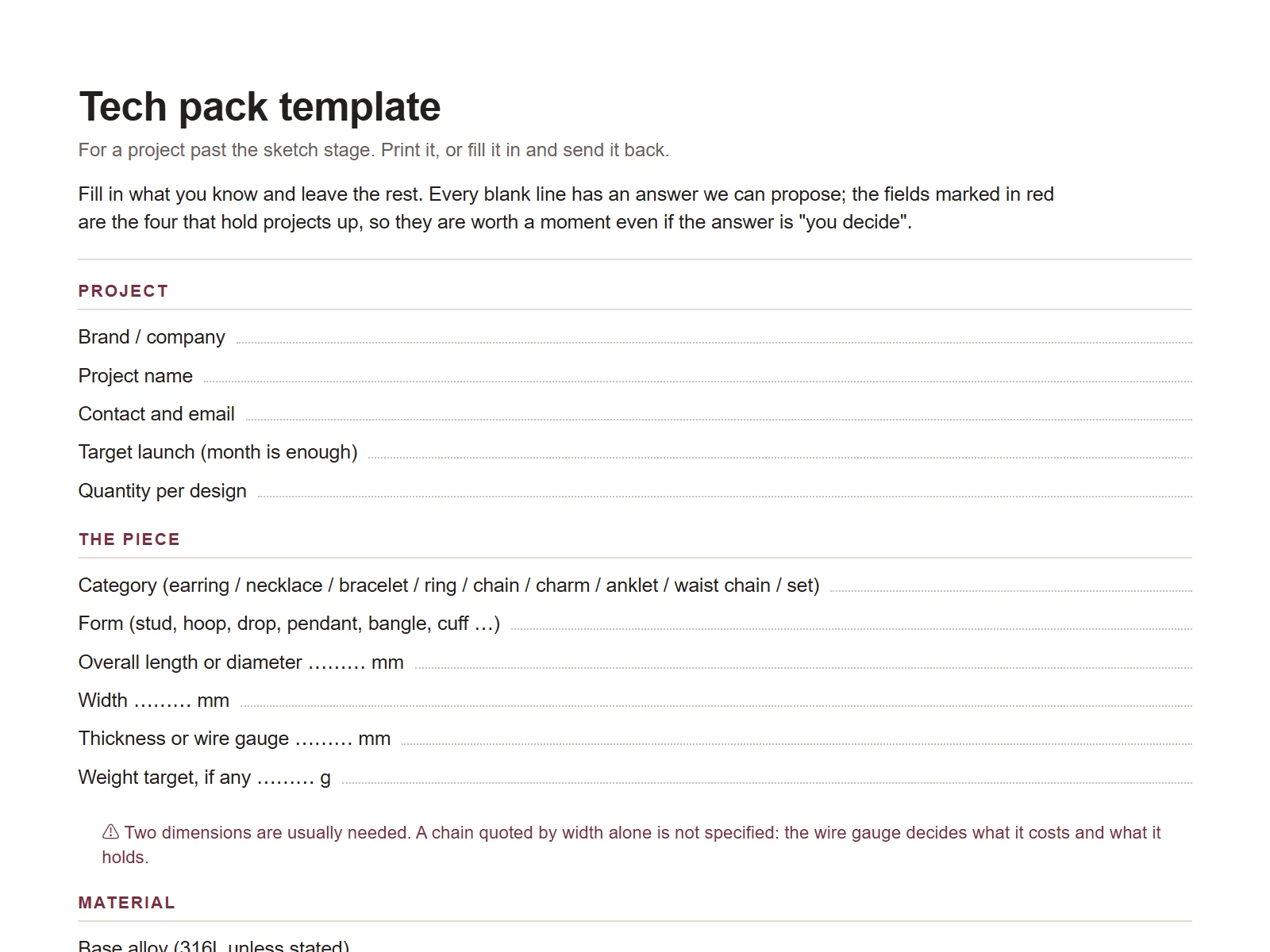
A fuller template with drawing frames and a specification table, for projects past the sketch stage.
Frequently asked questions
What is a tech pack?
A document that tells a factory what to make, precisely enough that two different people reading it would build the same thing. In practice it covers dimensions, materials, finishes, tolerances and construction notes, and usually runs to a few pages.
Can I start without one?
Yes, and most first-time customers do. A reference photograph and a description of what should differ is enough to get a feasibility read. We often build the tech pack with you during sampling, so you do not need one before you get in touch.
What happens if a dimension is missing?
We ask. An assumed dimension produces a sample that is wrong in a way nobody predicted, and that costs a sample round. So we list the missing fields and send them back to you to fill in.
Do you need a CAD file?
No. CAD makes the first sample faster and more accurate, and if you have it we will use it. If you do not, a dimensioned drawing works, and a photograph with the main dimensions written on it works too. We have started projects from a napkin sketch.
Once the design is ready, send it. An NDA can be in place first. If you would rather see our work before sending anything, start with a sample.
Last updated